Choosing Ankle Sport Socks for wholesale requires more than comparing colors, prices, and carton quantities. Retailers must examine how each pair performs during repeated movement. Ankle Sport Socks should manage moisture, reduce friction, and stay secure inside running shoes. A loose cuff can distract athletes. Rough seams can create painful pressure points. Small defects become expensive when thousands of pairs reach customers.
“As Dr. Emily Splichal, a podiatrist and human movement specialist, has said, ‘The foot is the foundation of the body.’” This principle matters when evaluating wholesale socks. Buyers should inspect fiber composition, ventilation zones, arch support, cushioning, and heel reinforcement. Polyester blends may dry quickly. Cotton can feel comfortable but may retain moisture. Merino wool offers temperature control, though its cost can challenge mass-market pricing. No material wins every situation.
A practical wholesale review should include sample testing before large production. Wear the socks during short runs, gym sessions, and ordinary walks. Check whether the cuff leaves marks after several hours. Wash samples repeatedly. Then compare shrinkage, color stability, odor control, and seam strength. Packaging and size labels also deserve attention. They influence returns and customer trust.
The imperfect part is often ignored. A sock may feel excellent but perform poorly after washing. A low price may hide weak elastic. Buyers should question attractive claims and request test evidence. This guide explains how to compare suppliers, assess product quality, and select Ankle Sport Socks that support both athletes and sustainable wholesale sales.
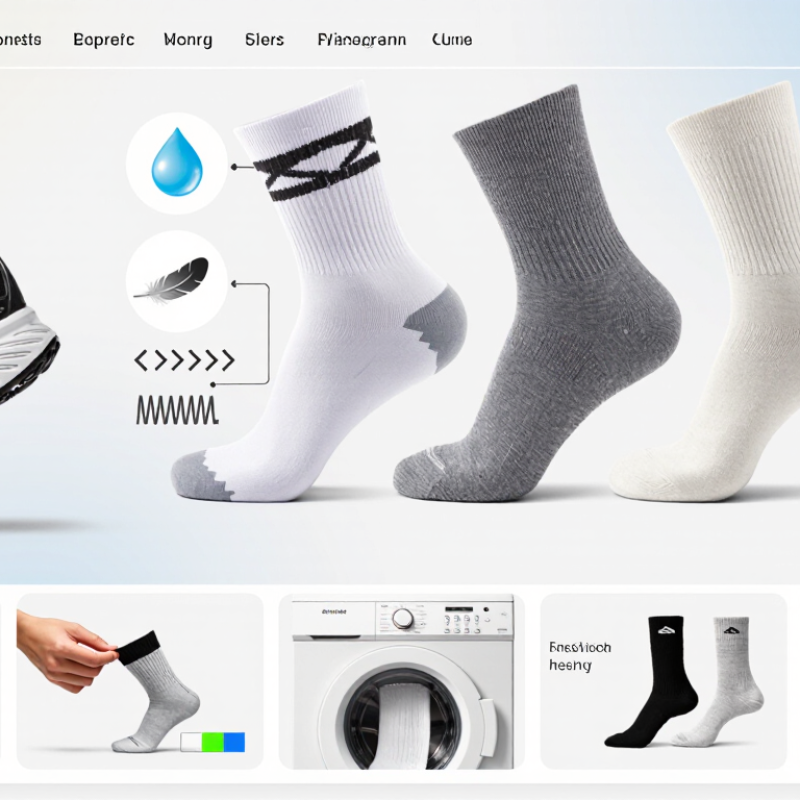
Define Wholesale Requirements: Ankle Height, Fiber Blend, Sizes, and MOQ
Choosing ankle sport socks for wholesale starts with a precise product brief. Ankle height should sit below the ankle bone without slipping during sprints or court drills. Ask for a measured cuff height, not only “low cut.” A 3–5 centimeter cuff can feel very different across foot shapes. Check heel coverage, arch support, toe seams, cushioning, and ventilation. Request pre-production samples and test them after repeated washing. A sock that feels excellent on day one may loosen after ten cycles.
Fiber blend affects comfort, drying speed, durability, and cost. Polyester supports quick drying, while cotton gives a softer hand feel. Nylon can improve abrasion resistance, and elastane helps recovery. Percentages matter, but knitting density matters too. Compare samples under the same activity and wash conditions. Size planning needs real sales data, not guesswork. Review local foot-length ranges, then request a size chart in centimeters. Mixed-size cartons may reduce inventory risk, yet they can complicate packing and reorder calculations. MOQ should match your cash flow and launch forecast. A low MOQ helps only when quality remains consistent.
Tips: Ask for separate quotes by fiber blend, color, size ratio, and packaging. Confirm whether MOQ applies per color or design. Keep one retained sample for future inspections. I once focused too heavily on unit price and overlooked uneven cuffs. That mistake was expensive. Leave room for a small test order before scaling. Record shrinkage, pilling, and colorfastness results, because supplier claims need practical verification.
Compare Moisture Management with AATCC TM195 Testing Data
How to Choose Ankle Sport Socks for Wholesale?
Compare Moisture Management with AATCC TM195 Testing Data
Wholesale buyers should examine moisture management before choosing ankle sport socks. Feet release heat and sweat during running, training, and long work shifts. AATCC TM195 evaluates how textile fabric handles liquid moisture. The test can report wetting time, absorption rate, spreading speed, one-way transport, and overall moisture management capacity.
Lower wetting time usually indicates faster liquid contact. Strong spreading speed can help distribute moisture across a wider area. One-way transport shows whether moisture moves away from the skin-facing side. However, a high overall score does not guarantee a dry feeling in every shoe. Sock thickness, tightness, cushioning, and ventilation also affect comfort.
Ask suppliers for complete test reports, not only a single score. Check the fabric composition, test date, sample side, and laboratory conditions. Compare identical sock constructions when reviewing different samples. A lightweight polyester blend may spread moisture quickly, while a thicker cushioned sock may absorb more liquid but dry more slowly. Mesh zones can improve airflow, yet poor ankle elasticity may cause slipping. Small details matter.
Do not treat TM195 data as a complete product judgment. It measures textile moisture behavior under controlled conditions, not every movement on a real court. Request physical samples and test them after washing. Check the heel, toe, arch support, and cuff during actual wear. One sourcing mistake is trusting impressive numbers without checking construction. Performance data needs context.
How to Choose Ankle Sport Socks for Wholesale? - Compare Moisture Management with AATCC TM195 Testing Data
| Sample ID |
Sock Construction |
Recommended Use |
Wetting Time
(seconds, lower is better) |
Absorption Rate
(%/second, higher is better) |
Maximum Wetted Radius
(mm) |
Spreading Speed
(mm/second, higher is better) |
Accumulative One-Way Transport
(mm) |
OMMC
(0–1 index) |
Moisture Management Rating |
| Top |
Bottom |
Top |
Bottom |
| AS-01 |
Cotton-rich terry knit with elastane support zones |
Casual walking |
8.6 |
9.4 |
17.8 |
16.2 |
23.6 |
2.7 |
48 |
0.31 |
Low |
| AS-02 |
Polyester mesh body with elastane compression arch |
Gym training |
3.8 |
4.1 |
31.6 |
29.8 |
29.4 |
4.6 |
86 |
0.58 |
Medium |
| AS-03 |
Polyester-polyamide blend with ventilated instep mesh |
Running |
2.9 |
3.2 |
39.4 |
37.1 |
32.8 |
5.8 |
109 |
0.72 |
Good |
| AS-04 |
Polypropylene performance yarn with dry-touch inner face |
High-intensity sport |
2.1 |
2.4 |
47.8 |
45.6 |
35.1 |
6.7 |
128 |
0.84 |
Excellent |
| AS-05 |
Recycled polyester knit with cushioned sole and elastane |
Outdoor fitness |
3.4 |
3.7 |
35.2 |
33.5 |
30.6 |
5.1 |
97 |
0.66 |
Good |
| AS-06 |
Bamboo-viscose blend with polyester reinforcement yarn |
Lifestyle sport |
5.7 |
6.2 |
25.4 |
23.9 |
26.8 |
3.8 |
68 |
0.45 |
Medium |
Testing and purchasing notes: The table uses AATCC TM195 moisture-management indicators, including wetting time, absorption rate, spreading behavior, accumulative one-way transport, and Overall Moisture Management Capacity (OMMC). Higher OMMC, faster spreading, and greater one-way transport generally indicate better sweat transfer from the foot toward the outer sock surface. Results can vary with yarn lot, knit density, finishing treatment, laundering, specimen conditioning, and test laboratory settings. Confirm production lots with an accredited laboratory before making wholesale performance claims.
Verify Fit and Durability Using ISO Sizing and ASTM D4966 Results
Wholesale ankle socks should be checked like technical products, not colorful accessories. ISO 9407:2019 defines Mondopoint sizing through measured foot length and width. Ask suppliers to map every size to a specific foot-length range. Measure samples on real feet, too. Check heel placement, ankle pressure, and toe-seam movement after walking. A 25 cm foot should not sit inside a vague “medium” label. Small detail. It can prevent mixed-size returns. The World Footwear Yearbook 2024 reported approximately 22.4 billion footwear pairs were produced globally in 2023. Large-volume sourcing makes consistent sizing more valuable, not less.
For durability, request ASTM D4966-12(2021) Martindale abrasion results. The report should identify fabric construction, abrasive material, applied load, and failure point. Compare cycles to a visible hole or defined mass loss. Higher cycle counts usually suggest better abrasion resistance, but they are not a universal pass mark. I would not trust one impressive number alone. Ask for testing on the heel and toe zones, where friction is concentrated. Request results before and after repeated washing, because a sock may survive the machine but fail during wear. ISO sizing confirms the intended fit; ASTM data helps expose weak yarns and thin knitting. Still, laboratory conditions are imperfect. Real users walk differently. Sources: ISO 9407:2019; ASTM D4966-12(2021); World Footwear Yearbook 2024.
How to Choose Ankle Sport Socks for Wholesale?
ISO Mondopoint foot-length references compared with supplier-neutral ASTM D4966 abrasion-screening results.
Use ISO Mondopoint measurements to verify that the sock size matches the intended foot-length range.
ASTM D4966 evaluates abrasion resistance using repeated rubbing cycles; higher cycle counts generally indicate
better resistance to surface wear. Confirm all values with independent laboratory reports before placing a wholesale order.
Set Quality Controls with AQL 2.5, GSM, and ISO 105 Colorfastness
When choosing ankle sport socks for wholesale, quality control should begin with measurable specifications. AQL 2.5 is a practical sampling level for bulk inspections. It does not mean every pair is defect-free. It means the selected batch meets an agreed acceptance limit. Define critical, major, and minor defects before production. Check loose threads, uneven toe seams, holes, stains, and stretched cuffs.
GSM helps compare fabric weight between suppliers. Measure it from the same sock size and construction. A heavier sock may improve cushioning, but excessive weight can reduce breathability. Ask for the fiber blend, knitting structure, and GSM tolerance. Inspectors should weigh random samples, not only the approved sample. Small differences can become uncomfortable after several hours of training.
Colorfastness also needs a test method. ISO 105 includes different procedures for washing, rubbing, and perspiration. Request the exact test reference, temperature, detergent, and rating. Dark ankle socks should not leave visible dye on a white towel after damp rubbing. They should also retain a stable color after repeated washing. A laboratory report adds confidence, but it cannot replace production checks. A perfect report can still miss a weak seam. I have seen attractive samples fail after packing pressure and heat. Review failed batches honestly, then adjust yarn, knitting tension, or finishing controls before confirming the wholesale order.
Calculate Landed Cost from MOQ, Compliance, Packaging, and Lead Time
How to Choose Ankle Sport Socks for Wholesale?
Calculate Landed Cost from MOQ, Compliance, Packaging, and Lead Time
A low factory price can hide expensive landed costs. Build a worksheet before approving ankle sport socks. Include product price, inspection, testing, freight, duty, insurance, and domestic delivery. The landed-cost formula is simple: total delivered cost divided by sellable pairs. For example, 10,000 pairs at 1.20 USD cost 12,000 USD. Add 420 USD for compliance testing, 680 USD for packaging, and 1,900 USD for freight and import charges. The estimated cost becomes 1.50 USD per pair, before local storage.
MOQ changes the calculation. If custom colors require 5,000 pairs per color, slow-moving shades can lock up cash. Ask for a size and color breakdown. Also record rejected pairs, not only ordered pairs. A 2% quality loss changes the real cost to approximately 1.53 USD. Small errors matter. Review this assumption.
Compliance costs should match the destination market. Check fiber-content labeling, restricted-substance testing, care instructions, and packaging rules with a qualified laboratory or customs adviser. The Textile Exchange Materials Market Report 2024 reported global fiber production at about 124 million tonnes in 2023, with polyester remaining dominant. Material claims therefore need evidence, not supplier wording alone. Keep test reports linked to each fabric lot.
Packaging adds more than printing. A carton holding 100 pairs may reduce handling costs, but oversized cartons increase freight volume. The UNCTAD Review of Maritime Transport 2024 states that ships carry over 80% of world trade by volume. Freight timing remains exposed to congestion and route changes. Add a realistic buffer to the quoted lead time, especially when sampling, testing, and packaging approval happen separately. Fast delivery is not always cheaper.
FAQS
Use measured foot length and width, not vague labels like “medium.” Map every size to a defined foot-length range. A 25-centimeter foot needs a clear size.
Test samples on real feet. Check heel placement, ankle pressure, and toe-seam movement after walking. The fit may look correct but still feel uncomfortable. Small details matter.
Request abrasion results using a recognized Martindale testing method. The report should show fabric construction, abrasive material, load, and failure point. Ask whether failure means a hole or mass loss.
Higher cycle counts usually indicate stronger abrasion resistance. They are not a universal pass mark. One impressive number is insufficient. Test heel and toe zones separately.
Repeated washing can weaken yarns and thin knitted areas. Request results before and after washing. A sock may survive the machine but fail during daily walking. Laboratory conditions are imperfect.
Add product price, inspection, testing, freight, duty, insurance, and local delivery. Divide the total delivered cost by sellable pairs. For example, 10,000 pairs may begin at 12,000 dollars. After added costs, the estimate could reach 1.50 dollars per pair.
Ask for the minimum order by color and size. A slow-moving color can lock up cash. Record rejected pairs, not only ordered pairs. A 2% quality loss may raise 1.50 dollars to approximately 1.53 dollars. Review that assumption.
Check fiber-content labels, restricted-substance testing, care instructions, and packaging rules. Use a qualified laboratory or customs adviser for destination requirements. Material claims need evidence. Link each report to its fabric lot.
A carton holding 100 pairs may reduce handling work. Oversized cartons can increase freight volume. Include buffers for sampling, testing, and packaging approval. Fast delivery is not always cheaper. Schedules slip.
Conclusion
Choosing Ankle Sport Socks for wholesale requires a clear evaluation of both product specifications and total purchasing costs. Start by defining the required ankle height, fiber blend, size range, color options, and minimum order quantity (MOQ). Moisture management should be assessed through practical performance data, including AATCC TM195 testing, to confirm that the fabric can help move sweat away from the skin during sports activities. Fit and durability should also be verified through ISO sizing references and ASTM D4966 abrasion results, ensuring the socks remain comfortable and functional after repeated use.
Before placing an order, establish quality controls based on AQL 2.5, suitable GSM, and ISO 105 colorfastness requirements. Finally, calculate the landed cost by including the unit price, MOQ, compliance testing, packaging, shipping, and expected lead time. This structured approach helps buyers compare suppliers objectively, reduce quality risks, and select ankle socks that meet performance, consistency, and budget expectations.

 Cmax Textile