Choosing the best Grip Socks for wholesale requires more than comparing prices or counting silicone dots. Retailers need products that feel secure during movement, survive repeated washing, and look consistent on store shelves. Podiatrist Dr. Emily Splichal states, “The foot is the foundation of the body.” That foundation deserves thoughtful product selection.
A reliable wholesale evaluation begins with the yarn, stretch, heel construction, and grip pattern. Cotton-rich blends may feel soft, while nylon or polyester can improve durability and drying speed. The right balance depends on the customer and activity. Yoga studios may prefer flexible socks with full-foot grip. Pilates customers may value arch support and breathable panels. Dance buyers often need a close fit and clean toe movement.
Samples reveal details that catalogs hide. Check whether the silicone grips remain attached after several washes. Examine loose threads, uneven sizing, and unpleasant chemical odors. Test the socks on wood, tile, and studio flooring. A low price can look attractive. It can also become an expensive mistake. Ask suppliers about material specifications, size charts, packaging, minimum order quantities, and production lead times. Request inspection records when available, and verify labeling requirements for your target market. Claims about non-slip performance should be supported by practical testing, not attractive photographs.
No checklist is perfect. Some buyers may overlook packaging quality, while others may overvalue thick fabric. That uncertainty matters. The strongest wholesale choice combines comfort, dependable grip, stable quality, and realistic margins. Before placing a large order, compare samples from several suppliers. A small test order may prevent a much larger disappointment.
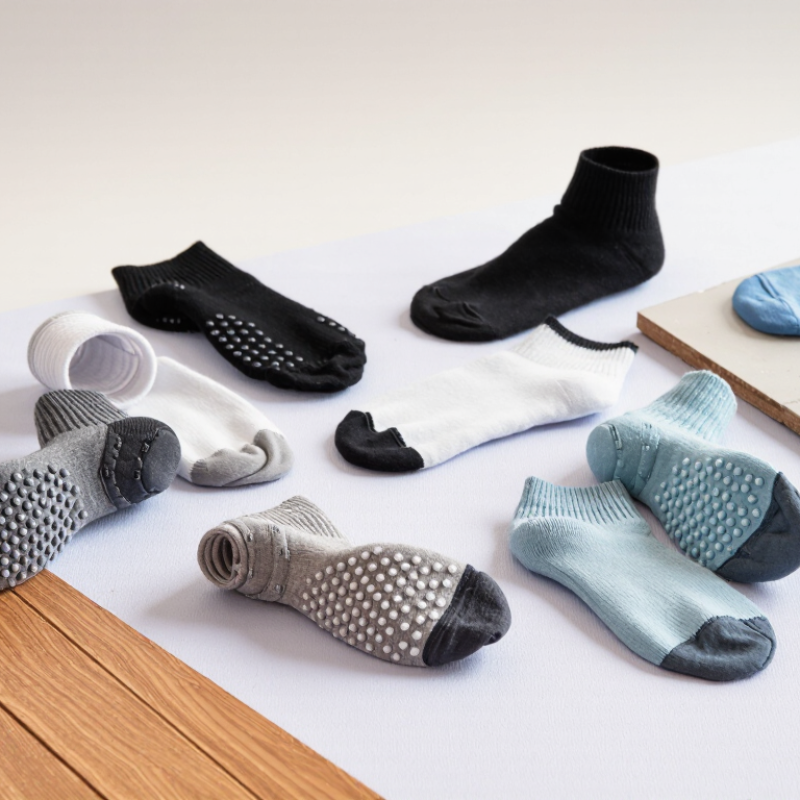
Wholesale buyers should define the use case before comparing prices. Pilates studios may need quiet, flexible socks with reliable grip under the forefoot. Yoga spaces may prefer breathable cotton blends and full-sole traction. Trampoline facilities need stronger coverage and better ankle support. Small details matter.
Demand is growing around studio-based fitness. The 2024 ClassPass fitness report recorded Pilates as the most-booked workout worldwide, with bookings rising 66% year over year. Grand View Research valued the global sports apparel market at approximately 248.9 billion dollars in 2023. These figures do not prove grip-sock demand alone. They do show a wider market for performance-focused apparel. Buyers should still test their own customer data.
Build a practical specification sheet. Include adult and children’s sizes, target order quantities, fabric composition, grip pattern, cuff height, packaging, and expected reorder timing. Request abrasion tests, wash-cycle results, and shrinkage measurements. A sock that grips well on dry studio flooring may fail after repeated washing.
I learned this the hard way.
Do not choose the densest silicone pattern automatically. It can reduce flexibility and increase production cost. Check whether the grip remains stable during lunges, jumps, and controlled footwork. Ask for samples from several batches, not one perfect sample. Review defect rates, color consistency, and size tolerances. A low unit price may become expensive when returns, relabeling, and slow-moving sizes appear.
For wholesale buyers, grip socks should be judged by material, grip pattern, and tested performance. Cotton feels soft and absorbs sweat, but it may dry slowly after repeated washing. Nylon and polyester improve durability and moisture control. A small amount of elastane helps the sock stay secure without excessive pressure. Some suppliers use bamboo blends, although softness can hide weaker abrasion resistance. Check fiber percentages, stitching, and shrinkage before placing a large order. Start with samples. That step prevents expensive guesses.
Grip patterns affect both movement and comfort. Silicone dots provide flexible contact under the forefoot and heel. Full-sole coverage can suit studio training, but it may feel warm during long sessions. Honeycomb or raised lines can improve traction while allowing foot movement. Dense patterns are not automatically better. Test socks on wood, rubber, and smooth tile-like surfaces, because grip changes with flooring. Inspect the print after ten washes. Peeling edges are a warning.
Performance features should match the buyer’s use case. A reinforced heel reduces wear during repeated pivots. Arch compression can improve a close fit, but tight bands may irritate wider feet. Seamless toes reduce rubbing, while breathable zones help manage heat. For wholesale evaluation, record slip resistance, stretch recovery, colorfastness, and washing results. Compare sizes on real feet, not only packaging charts. A thick sock may feel premium, yet limit balance. This is an easy mistake. Packaging clarity also matters, because unclear sizing can create returns. Reliable suppliers should provide consistent measurements, material details, and test records.
Size accuracy should lead every wholesale decision. Grand View Research valued the global socks market at USD 42.2 billion in 2022, with a projected 6.0% CAGR from 2023 to 2030. This growth increases the cost of poor sizing. Ask suppliers for foot-length measurements, not only S, M, and L labels. Test narrow, standard, and wide feet. Check whether the elastic leaves marks after a 60-minute class. A perfect size curve is rare. Your first forecast may need revision.
Design must match the customer’s activity. Pilates users often prefer low-profile silicone grips and a flexible arch band. Studio dancers may need heel coverage and lighter fabric. For fitness buyers, ventilation zones and reinforced toes can matter more. Keep grip patterns dense under the forefoot, but avoid excessive rubber that restricts movement. Compare samples after washing them at least five times. Small details matter.
Customization can include colors, cuff height, grip shapes, packaging, and woven logos. Textile Exchange’s 2024 Materials Market Report states that polyester represented about 57% of global fiber production in 2023. Therefore, request clear fiber percentages and recycled-content evidence when sustainability claims influence purchasing. Confirm minimum order quantities, colorfastness tests, packaging dimensions, and production tolerances in writing. A custom design may look excellent on screen but feel wrong on the foot. That mistake is easy to overlook.
How to Choose the Best Grip Socks for Wholesale?
When buying grip socks wholesale, supplier quality deserves more than a polished catalog. Request production samples in your target sizes, colors, and fabric weight. Check whether silicone grips cover the heel, forefoot, and arch evenly. Stretch the socks repeatedly and inspect loose threads, odor, shrinking, and peeling after washing. Small flaws become expensive when multiplied across thousands of pairs.
Ask the supplier for valid certifications and confirm their scope, issuing body, and expiry date. A quality-management certificate can show controlled processes, but it does not prove every sock is safe or durable. Request material test reports for fiber content, colorfastness, and restricted substances. Review the factory’s inspection records, not only promotional documents. The paperwork should match the actual production site.
Production capacity also affects wholesale reliability. Ask how many machines handle your order, what the normal lead time is, and how peak-season delays are managed. Clarify minimum order quantities, replacement policies, and batch traceability. A supplier may promise fast delivery, yet outsource part of the work without explaining it. That is a warning sign. I once focused too heavily on unit price and overlooked inconsistent sizing between samples. The cheaper offer became costly after rework and customer complaints. An on-site or video audit cannot reveal everything, but it exposes missing equipment, crowded storage, and weak quality checks. Leave room for doubt. Verify before scaling.
Supplier evaluation priorities based on quality control, certifications, production capacity, and delivery reliability.
Quality inspection should receive the highest weighting because grip socks require consistent silicone grip adhesion, fabric durability, size accuracy, and colorfastness. Verify relevant certifications such as ISO 9001 and OEKO-TEX STANDARD 100, then confirm monthly capacity, lead-time consistency, and the supplier’s ability to meet wholesale order volumes.
How to Choose the Best Grip Socks for Wholesale?
Wholesale grip socks should be priced from landed cost, not factory price alone. Add materials, knitting, silicone grip printing, packaging, inspection, freight, duties, and payment fees. A practical formula is: unit cost plus total expenses, divided by sellable units. Then apply your target margin. Grand View Research valued the global sports apparel market at about USD 249 billion in 2023, showing strong demand, but large markets also create intense price pressure.
Minimum order quantities need careful testing. Ask suppliers for prices at 100, 300, 500, and 1,000 pairs. Compare the price reduction with your storage risk. For example, a 500-pair order may lower unit cost by 12%, yet tie up cash for months. Keep sizes and colors limited at the beginning. A small pilot order is safer, although it may produce a weaker margin. That trade-off is easy to underestimate.
Delivery terms can change the final price sharply. Request separate quotes for EXW, FOB, and DDP, with production and transit times shown separately. The World Bank’s Logistics Performance Index 2023 evaluates 139 economies and highlights customs, infrastructure, and shipment reliability as major logistics factors. Build a buffer of at least seven to fourteen days for inspections or port delays. Confirm carton dimensions, gross weight, and replacement terms in writing. I would not trust a “fast delivery” promise without a dated production schedule. Mistakes happen.
Indicative wholesale planning benchmarks for standard adult grip socks. Final quotations depend on material, customization, packaging, order volume, and shipping destination.
| Product Option | Typical Material | Grip Construction | Indicative Unit Price (USD) | Typical MOQ | Sample Lead Time | Bulk Production Time | Estimated Sea Freight Transit | Suitable Buyer |
|---|---|---|---|---|---|---|---|---|
|
Basic Low-Cut Grip Socks
Entry Level
|
80% cotton, 17% polyester, 3% elastane | Silicone or PVC dots on the sole | $0.65–$1.05 | 500–1,000 pairs per color | 7–10 days | 20–30 days after approval | 25–40 days | Fitness studios, promotional programs, and value-focused retailers |
|
Standard Crew Grip Socks
Best Overall Value
|
75% cotton, 22% polyester, 3% elastane | Full-sole silicone grip with arch support | $0.90–$1.45 | 500–1,000 pairs per color | 7–12 days | 25–35 days after approval | 25–40 days | Yoga, Pilates, barre, dance, and general sports retailers |
|
Performance Grip Socks
Higher Performance
|
60% nylon, 35% polyester, 5% elastane | High-density silicone grip, mesh ventilation, cushioned sole | $1.35–$2.25 | 1,000–2,000 pairs per color | 10–14 days | 30–45 days after approval | 25–40 days | Sports clubs, premium studios, and performance-focused retailers |
|
Organic-Cotton Grip Socks
Sustainability Focus
|
70% certified organic cotton, 27% recycled polyester, 3% elastane | Water-based or silicone grip pattern | $1.50–$2.60 | 1,000–2,000 pairs per color | 12–18 days | 35–50 days after approval | 25–40 days | Eco-conscious retailers and premium wellness businesses |
|
Custom Jacquard Grip Socks
Brand Customization
|
Polyester, cotton, nylon, and elastane blend according to specification | Custom knitted pattern plus silicone sole grip | $1.20–$2.40 | 1,000–3,000 pairs per design | 14–21 days | 35–55 days after approval | 25–40 days | Private-label programs, event merchandise, and multi-location studios |
|
Individually Gift-Boxed Pair
Retail Ready
|
Material selected from standard or performance constructions | Grip specification selected from the base product | $1.65–$3.10 | 1,000–3,000 pairs per packaging design | 14–21 days | 40–60 days after packaging approval | 25–40 days | Gift retailers, e-commerce fulfillment, and premium retail displays |
Pricing and delivery notes: Unit prices generally refer to product cost only and may exclude packaging, inspection, duties, taxes, payment fees, and freight. Minimum order quantities can change when multiple colors, sizes, custom labels, or special packaging are required. Air freight commonly takes about 5–10 days, while express courier delivery commonly takes about 3–7 days, excluding customs clearance. For budgeting, buyers should request a landed-cost quotation based on the final destination and Incoterm.
Define the activity, user ages, order volume, fabric, grip design, cuff height, packaging, and reorder schedule. Small details matter. A studio may need quiet, flexible socks, while jump-based training needs stronger coverage and ankle support.
Cotton feels soft and absorbs sweat, but it may dry slowly after washing. Nylon and polyester usually improve durability and moisture control. A little elastane helps the sock stay secure. Bamboo blends can feel soft, yet softness may hide weak abrasion resistance.
No. Dense silicone coverage can reduce flexibility and raise production costs. Test forefoot and heel traction during lunges, jumps, and controlled footwork. More grip is not always more comfort. That assumption can become expensive.
Test samples on wood, rubber, and smooth tile-like floors. Grip performance changes with the surface. Inspect the print after ten washes. Peeling edges are a warning sign.
Reinforced heels can reduce wear during repeated pivots. Seamless toes may reduce rubbing. Breathable zones help manage heat. Arch compression supports a close fit, but tight bands may irritate wider feet.
Request wash-cycle results, shrinkage measurements, abrasion tests, and colorfastness records. Compare the sock before and after repeated washing. A strong grip on day one proves little. I would test several batches, not one perfect sample.
Offer suitable adult and children’s sizes when the customer base requires them. Compare socks on real feet, not only packaging charts. Record size tolerances and stretch recovery. Unclear sizing can create avoidable returns.
Packaging should clearly show sizes, fiber percentages, care instructions, and use information. Include consistent measurements across every production batch. Clear labels help stores and customers choose correctly. Even good socks can move slowly when sizes are confusing.
Compare total cost, not only the unit price. Include defects, returns, relabeling, slow-moving sizes, and replacement shipments. Request samples before placing a large order. Cheap can mislead. I would also review customer data, because market reports cannot prove local demand.
Choosing the best Grip Socks for wholesale begins with clearly defining your business requirements, including the intended use, target customers, preferred styles, order volume, and expected performance. Compare materials such as cotton blends, nylon, and moisture-wicking fabrics, while evaluating grip patterns, elasticity, breathability, durability, and comfort. The right combination should match your market and provide reliable support during movement.
Next, review available sizes, colors, designs, packaging, and customization options to ensure the products fit your brand and customer preferences. Carefully assess each supplier’s product quality, certifications, manufacturing standards, production capacity, and ability to maintain consistent quality across large orders. Finally, calculate the complete purchasing cost by considering unit pricing, customization fees, minimum order quantities, samples, shipping, payment conditions, and delivery timelines. A supplier that offers transparent terms, stable production, and responsive communication can help you reduce purchasing risks and build a dependable wholesale supply chain.